Understanding Carbs: Total Carbs, Net Carbs and Dietary Fiber Explained
Total carbs, fibre, sugars, starch and net carbs explained, plus why US, UK, EU and Australian labels show different numbers.

Carbohydrate numbers confuse almost everyone. Two similar products can show 12 g of carbs and 4 g, and neither label is wrong.
The word “carbs” simply means different things depending on where the label was printed. Here is a plain-English guide to the three numbers you will meet most.
Total Carbohydrates
Total carbohydrate is the broadest figure. It covers sugars, starches and dietary fiber.
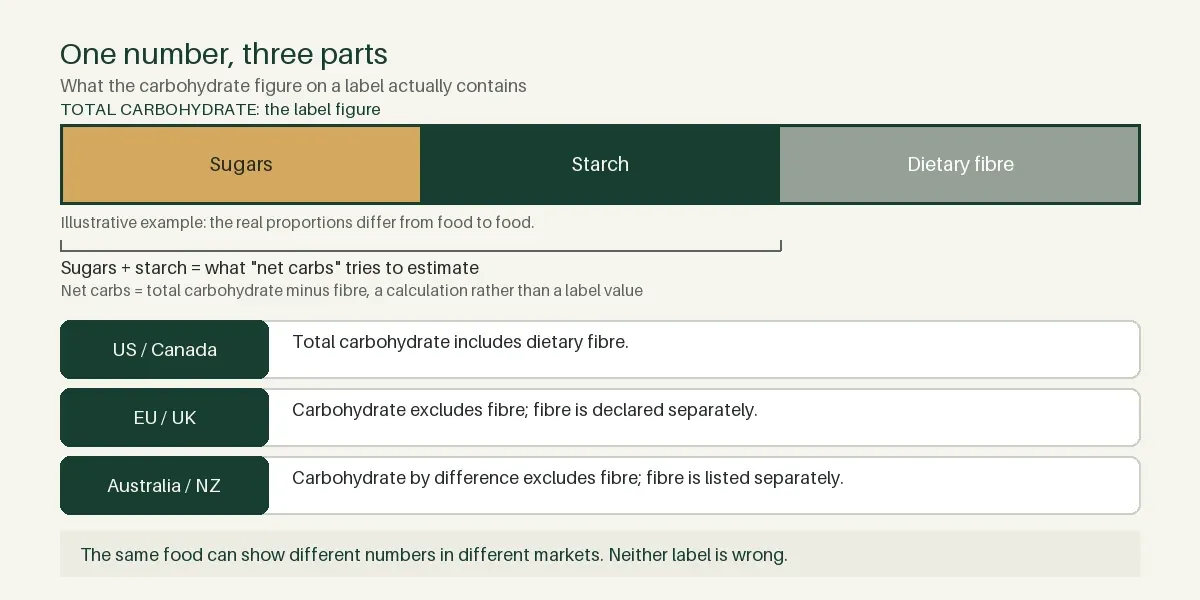
Simplified view. Net carbs is a subtraction someone performs, not a figure printed on a regulated label.
In the US and Canada, that total includes fiber [1][2]. So a food with 12 g of carbohydrate and 4 g of fiber shows 12 g, with the fiber listed underneath as part of that number.
Dietary Fiber
Fiber is carbohydrate your body cannot fully break down. It passes through largely undigested, which is what makes it useful for digestion, gut bacteria, cholesterol and blood sugar.
Most people do not get enough — UK guidance suggests around 30 g a day [6] — and reaching that while cutting back on grains, fruit and legumes takes effort.
Net Carbs
Net carbs usually means total carbohydrate minus fiber. The aim is to estimate the carbohydrate that affects blood sugar.
Two cautions matter.
First, the subtraction treats fiber and sugar alcohols as if they had no effect on blood sugar. That is a simplification: fiber is not one single substance, and sugar alcohols differ from each other. Their real-world effect is not identical.
Second, there is no single agreed definition. Different products and sources subtract different things, so two “net carb” figures for similar foods may not be comparable [7].
Treat net carbs as a rough estimate, not an official measure. For the shopping side of it, see eating low-carb on a budget.
Why Labels Differ
This is a labelling rule difference, not a nutrition disagreement.
- US and Canada: total carbohydrate includes fiber, so fiber sits inside the total [1][2].
- EU and UK: carbohydrate covers metabolised carbohydrate, and fiber is declared separately [4].
- Australia and New Zealand: more than one calculation is allowed. “Carbohydrate by difference” subtracts water, protein, fat, ash, alcohol, fiber and specified components from 100. “Available carbohydrate” is calculated from available sugars and starch, with Schedule 11 defining a separate available carbohydrate by difference [3][5].
The same food can therefore show different numbers in different countries. Neither label is wrong; they answer different questions. How those rules change the numbers on everyday foods is set out in our practical food list.
Reading a Label: Three Examples
A US label. Total carbohydrate 12 g, dietary fiber 4 g. The fiber sits inside the 12 g. Subtracting it gives 8 g of other carbohydrate, but the label does not ask you to do that.
A UK or EU label. Carbohydrate 8 g, fiber 4 g. Two separate lines. The 8 g already excludes fiber, so subtracting again would double-count.
A “net carbs” label. Usually the manufacturer’s own calculation. If the method is not stated, assume it is not comparable with another brand.
The Takeaway
Total carbohydrate is the full figure. Fiber is the part you cannot digest, and it belongs in your diet. Net carbs is a convenience, not a standard.
When a number surprises you, check which country’s rules the label follows and whether fiber sits inside or outside the total. That habit clears up most of the confusion.
References
- U.S. Food and Drug Administration. Interactive Nutrition Facts Label: Total Carbohydrate. https://www.accessdata.fda.gov/scripts/interactivenutritionfactslabel/total-carbohydrate.cfm — no publication date shown; accessed November 18, 2026.
- Canadian Food Inspection Agency. Elements within the Nutrition Facts table. https://inspection.canada.ca/en/food-labels/labelling/industry/nutrition-labelling/elements-within-nutrition-facts-table — no publication date shown; accessed November 18, 2026.
- Food Standards Australia New Zealand. Nutrition information panels. https://foodstandards.gov.au/consumer/labelling/panels — no publication date shown; accessed November 18, 2026.
- Regulation (EU) No 1169/2011 of the European Parliament and of the Council, Annex I (as retained in UK law). https://www.legislation.gov.uk/eur/2011/1169/annexes — accessed November 18, 2026.
- Australia New Zealand Food Standards Code — Standard 1.2.8, Nutrition Information Requirements, incorporating Schedule 11 (S11—3, calculation of available carbohydrate and available carbohydrate by difference). https://legislation.gov.au/F2015L00481 — consolidated version dated October 29, 2024; accessed November 18, 2026.
- NHS. How to get more fibre into your diet. https://www.nhs.uk/live-well/eat-well/digestive-health/how-to-get-more-fibre-into-your-diet/ — updated March 3, 2026.
- Banner L, Rice Bradley BH, Clinthorne J. Nutrient analysis of three low-carbohydrate diets differing in carbohydrate content. Frontiers in Nutrition. 2024;11:1449109. https://doi.org/10.3389/fnut.2024.1449109 — published August 30, 2024. Authors affiliated with Simply Good Foods USA, Inc. Cited here only for the observation that net-carbohydrate calculations vary between sources.
Thank you for reading The Keto Ledger.
Explore more articles →